- 0
- 1,357 word
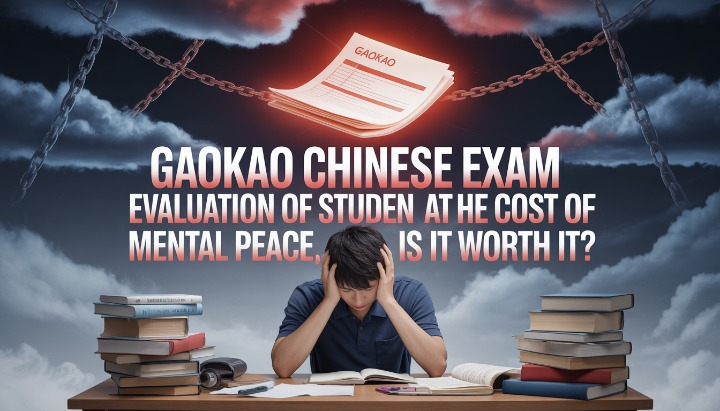
In today’s hyper-competitive world, students everywhere face academic pressure. But in China, one exam stands above all: the Gaokao, officially known as the National Higher Education Entrance Examination. It is not just a test. For millions of students, it becomes identity, reputation, family honor, and future, all compressed into a few days of examination.
Conducted only once a year, Gaokao is the primary gateway to colleges and universities across China. There is no easy retest option within the same year. If a student fails to secure the desired marks, they must wait an entire year to try again. That single attempt carries years of expectations.
The numbers themselves are overwhelming. In 1977, when the exam was reinstated after years of suspension, 5.7 million candidates appeared, but only around 200,000 secured admission. Fast forward to 2024, and 13.5 million students sat for the exam. While admission rates have increased to around 85%, entry into top universities remains fiercely competitive. For elite institutions, only about 0.1% truly make it.
This is why Gaokao is often described as more intense than many global competitive exams. For Chinese students, this is not just an academic test. It is a life-defining moment.
A Historical Shift That Changed Everything:
The roots of Gaokao trace back to 1952, just a few years after the establishment of the People’s Republic of China. Initially part of national matriculation policies, the exam system evolved over the decades. Until 1977, university admissions were largely influenced by political evaluations from the Communist Party, the People’s Liberation Army, and selected officials.
But in 1977, the system changed dramatically. Gaokao became the sole and standardized gateway to higher education. Merit measured through examination scores replaced political background as the primary criterion.
This shift was seen as fair in principle. A single exam meant equal opportunity for all. A rural student could compete with an urban student on the same paper. In theory, this system democratized education.
However, over time, this merit-based gateway turned into an intense national competition. Every mark began to matter. Families started reorganizing their lives around this exam. Entire school systems were reshaped for one purpose: cracking Gaokao.
The exam pattern itself evolved. From the 3 + X system to 3 + 1 + 2 and 3 + 3 formats, provinces adopted variations. Chinese, Mathematics, and a foreign language (usually English) remain compulsory. Students then select additional subjects such as Physics, Chemistry, Biology, History, Geography, or Political Science.
But regardless of format, one thing remains constant: the weight of expectation.
The “Gaokao Factories” and the Culture of Extreme Discipline:
In China, preparation for Gaokao has reached industrial intensity. One of the most famous examples is Maotanchang High School, often nicknamed the “Gaokao Factory.”
Here, students wake up before sunrise and study until nearly 11 p.m. Their day begins with a morning run, even in freezing temperatures. After that, collective reading sessions echo through classrooms. Students read loudly in unison, competing for clarity and precision. Every minute is structured. Even lunch breaks are limited to about 20 minutes. Power naps are scheduled. Conversations are minimized.
Mock exams determine status. Poor performance can lead to punishments such as writing self-criticism letters or standing during sessions. Teachers themselves are under immense pressure. Their reputation depends on student results.
Parents sacrifice heavily too. Some relocate homes closer to schools. Some rent tiny apartments they can barely afford. Some manage finances beyond their capacity, believing this one exam can transform their child’s destiny.
This system resembles exam-preparation hubs in other countries, like India’s Kota for IIT-JEE aspirants. But in China, the scale is national.
Exam Day – A Nation on Pause:
When Gaokao begins, the entire country seems to adjust around it.
Traffic rules are temporarily modified near exam centers. Construction sites pause work to reduce noise. Police are deployed from early morning. In some cities, drones monitor their surroundings. CCTV cameras supervise exam halls. Cheating is nearly impossible.
Parents drop their children at centers, waiting outside with flowers, snacks, and silent prayers. Social media is flooded with good wishes.
The exam lasts two to three days, depending on the subjects. Students may spend up to nine hours per day writing papers. The total score is 750. For admission into top universities, a score around 650 is often required.
For those targeting China’s elite institutions, the competition is brutal. Provincial quotas limit seats. Even high scorers can miss admission due to regional allocation.
This intensifies the pressure. Because in Gaokao, “not getting into a top university” is often perceived socially as failure.
The Hidden Cost – Mental Health Crisis:
Behind the success stories lies a silent crisis.
Studies suggest that around 65–72% of Gaokao candidates experience significant anxiety or mental health struggles. Headaches, sleep deprivation, stomach issues, and burnout are common. Many students isolate themselves from friends and family. Social life shrinks. Hobbies disappear.
Some reappear for the exam multiple times, four, five, or even six attempts. Years pass in preparation cycles. Self-esteem becomes tied entirely to marks.
In April 2025, an 18-year-old student preparing for Gaokao ended her life. She left a note written on the back of her test sheet. Once the second-highest scorer in her class, she felt reduced to falling marks and rising expectations. Her story shook the nation.
In response, mental health education was ordered to become mandatory in Chinese schools by the end of 2025. Yet academic pressure remains deeply embedded in the system.
The most heartbreaking moment comes after the exams end. Many students tear their books apart in frustration, not out of celebration, but out of emotional exhaustion. Years of pressure release in anger.
Is It Worth It?
Gaokao was designed to ensure fairness and equal opportunity. In many ways, it has done that. It has allowed millions from rural and modest backgrounds to enter prestigious universities through merit alone.
But the question remains at what cost?
When childhood turns into a constant race
When friendships become competition
When identity shrinks to a number out of 750
When anxiety replaces curiosity
We must ask whether evaluating a student’s entire worth through a single exam is truly justified.
Exams are important. Discipline is important. Ambition is important. But mental peace, creativity, and emotional health are equally important.
If you are a student struggling with exams, whether Gaokao, IIT-JEE, civil services, or any other, remember this: before you are an exam candidate, you are a human being. Your worth is not limited to one result sheet.
Education should build lives, not break spirits.
Final Thought:
Gaokao remains one of the toughest exams in the world. It symbolizes opportunity, equality, and ambition. But it also symbolizes pressure, anxiety, and sacrifice.
Perhaps the real challenge is not just passing Gaokao, but designing a system where success does not come at the cost of mental peace, and that is a question not just for China, but for every competitive society in the world.
FAQs:
1. What is the Gaokao exam, and why is it so important?
The Gaokao is China’s National Higher Education Entrance Examination. It is the primary pathway to universities, especially top institutions. For many students, it determines their academic future, career opportunities, and social mobility, making it one of the most important exams in their lives.
2. How difficult is the Gaokao compared to other exams?
Gaokao is considered one of the toughest exams globally due to its scale, competition, and pressure. Millions of students compete each year, and entry into elite universities is extremely limited, making the competition intense.
3. Can students retake the Gaokao if they fail?
Yes, students can retake the Gaokao, but only in the following year. This means they must dedicate another full year to preparation, which adds emotional and psychological pressure.
4. Why does Gaokao create so much mental stress?
The stress comes from multiple factors: high expectations from family, limited attempts, intense competition, and the belief that one exam can define a student’s future. This combination often leads to anxiety, burnout, and emotional strain.
5. Is Gaokao still a fair system despite the pressure?
In principle, Gaokao is designed to be fair because it offers equal opportunity based on merit rather than background. However, the extreme pressure and its impact on mental health raise important concerns about whether the system needs reform to balance fairness with well-being.
Author

officeworks1419@gmail.com
Related Posts
Is Your Engineering Degree USELESS Now? | The Class of 2026: When the Safe Career Stopped Being Safe:
- 0
- 1,727 word
Last week, a 22-year-old computer science student sent a message that perfectly captures what millions of graduates are feeling right now. He...
Read out all
The Real Cost of Competitive Exam – Can You Afford It?
- 0
- 1,553 word
The intro of this blog actually highlights the real scenario of the UPSC exam and its economic and psychological impact. The script...
Read out all